In the demanding world of aerospace engineering, precision, reliability, and compliance with stringent certification standards are non-negotiable. As aircraft systems increasingly rely on advanced electromechanical actuators, the need for highly accurate and versatile testing platforms has become critical. Rising to this challenge, Italian engineering specialist Excogita has developed an innovative multifunctional test bench that redefines how linear electromechanical actuators are validated for aeronautical applications. By replacing traditional hydraulic and pneumatic load systems with a high-performance linear electric motor, the company has introduced a smarter, more efficient, and highly responsive testing solution tailored to modern aerospace requirements.
Engineering Innovation at the Core
The newly developed test bench was designed to subject small- to medium-sized linear electromechanical actuators to a full spectrum of static and dynamic functional tests. These include limit load, ultimate load, endurance, backlash, irreversibility, dynamic performance, temperature resistance, and electrical data acquisition all conducted along the entire actuator stroke.
What sets this solution apart is its use of a linear electric motor as a dynamic resistive load generator. Traditionally, actuator testing has relied on hydraulic or pneumatic systems. While cost-effective, these conventional systems present significant challenges: limited force control flexibility, complex supply circuits, higher maintenance requirements, and restricted control precision especially when displacement-based control is required alongside force regulation.
Excogita’s electric approach eliminates these constraints. The electromagnetic linear motor allows precise control of position, velocity, acceleration, and force, delivering high dynamic performance at elevated cycle frequencies while reducing energy consumption and system complexity.
Collaborative Development for Advanced Performance
The project was realized in collaboration with CIMES (Interuniversity Consortium for Machines, Plants and Systems for Energy, Industry and Environment), combining industrial expertise with academic research excellence. This synergy enabled the creation of a platform capable of meeting aerospace-grade standards, where tight performance tolerances and repeatability are essential.
The objective was clear: to design a modular, multifunctional test bench capable of simulating real operating conditions with variable load curves across the full actuator stroke. The result is a general-purpose platform suitable both for prototype validation and for certification of established actuator products.
Multifunctional Architecture
To ensure versatility and cost efficiency, the system was conceived as a single modular platform capable of multiple test configurations. Its architecture includes:
- A welded load-bearing structure with integrated safety barriers.
- Dedicated fixtures to reproduce real stiffness conditions.
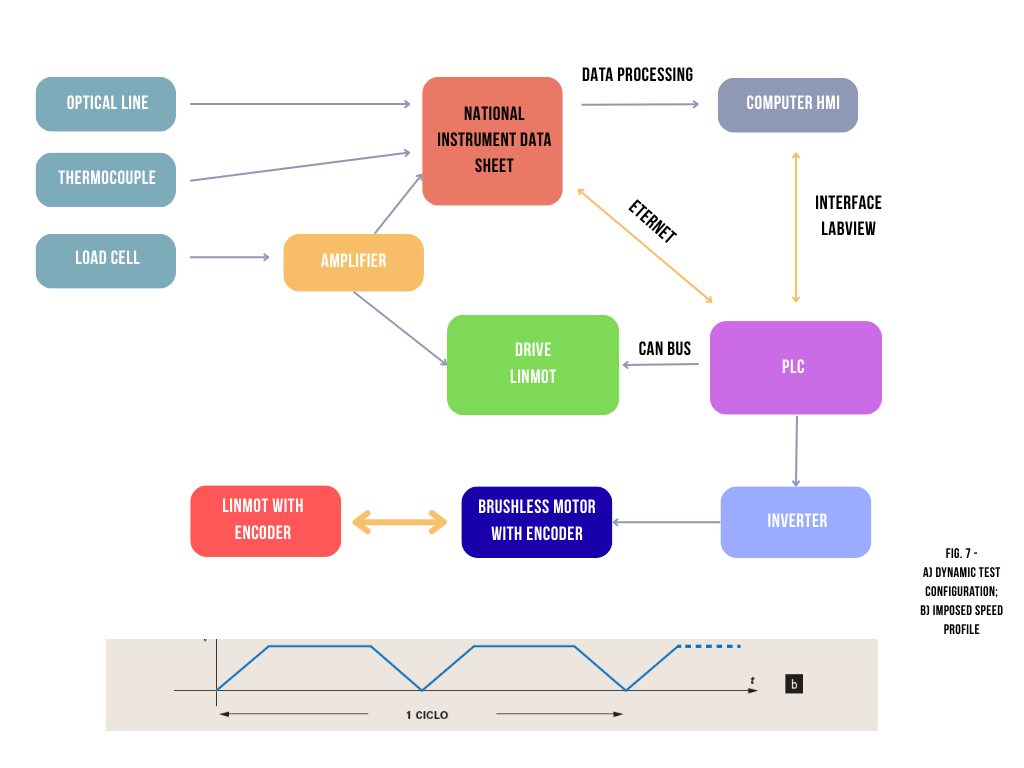
- A measurement chain comprising force, position, and temperature sensors.
- An HMI interface with PLC integration.
- National Instruments-based data acquisition and LabVIEW visualization.
- An optional thermal box for environmental testing
The integrated thermal chamber allows tests under extreme environmental conditions ranging from –60°C to +80°C at controlled humidity levels. Rapid thermal cycling and vibration testing further enable the identification of latent defects a critical requirement for aerospace certification.
The Linear Motor Advantage
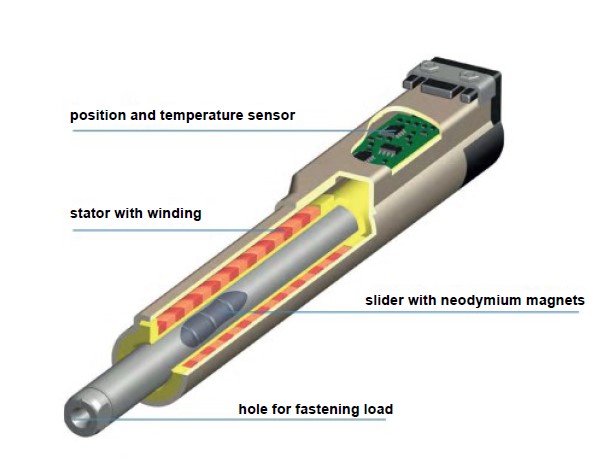
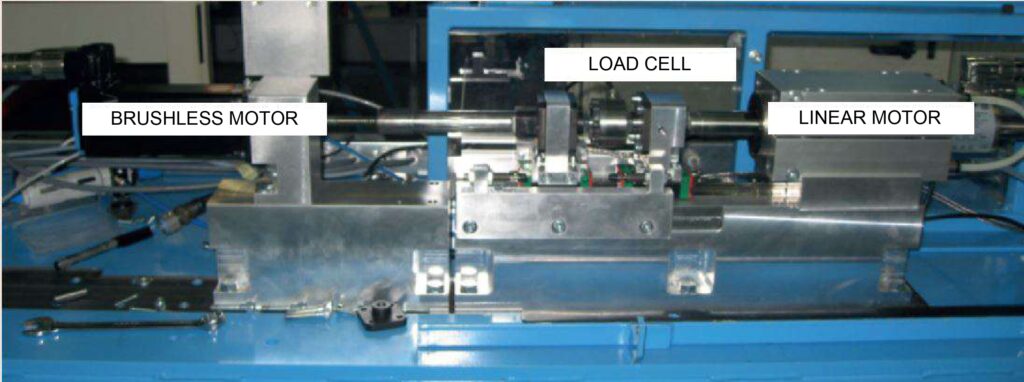
At the heart of the system lies a high-dynamic linear electric motor with integrated encoder feedback. Its electromagnetic operating principle ensures rapid response and high repeatability. Unlike hydraulic systems, the motor can seamlessly switch between passive mode (opposing actuator motion during dynamic tests) and active force application (for static load tests).
For high-load static tests exceeding the motor’s force capacity, the system can be reconfigured with a pneumatic piston, preserving flexibility without compromising performance.
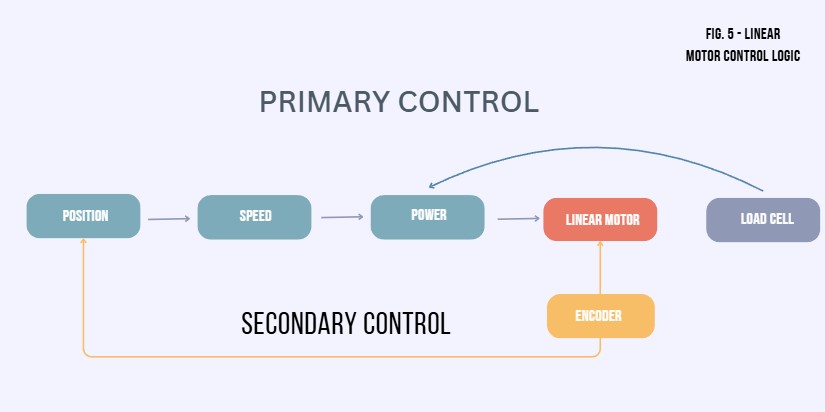
The integrated force feedback control system represents a significant technical achievement. Because aeronautical actuators often feature irreversible locking mechanisms and closed electronic control architectures, the linear motor must operate exclusively in force-control mode. A dedicated control algorithm ensures that during motion reversals typically the most critical phase overload conditions are avoided, preventing actuator shutdown or mechanical damage.
Precision Measurement and Control
The measurement chain guarantees accurate acquisition of force, displacement, and thermal data throughout testing. A load cell positioned between the actuator under test and the resistive load generator monitors axial force exchange in real time. Optical scales and encoders ensure precise displacement tracking, while temperature sensors provide thermal monitoring.
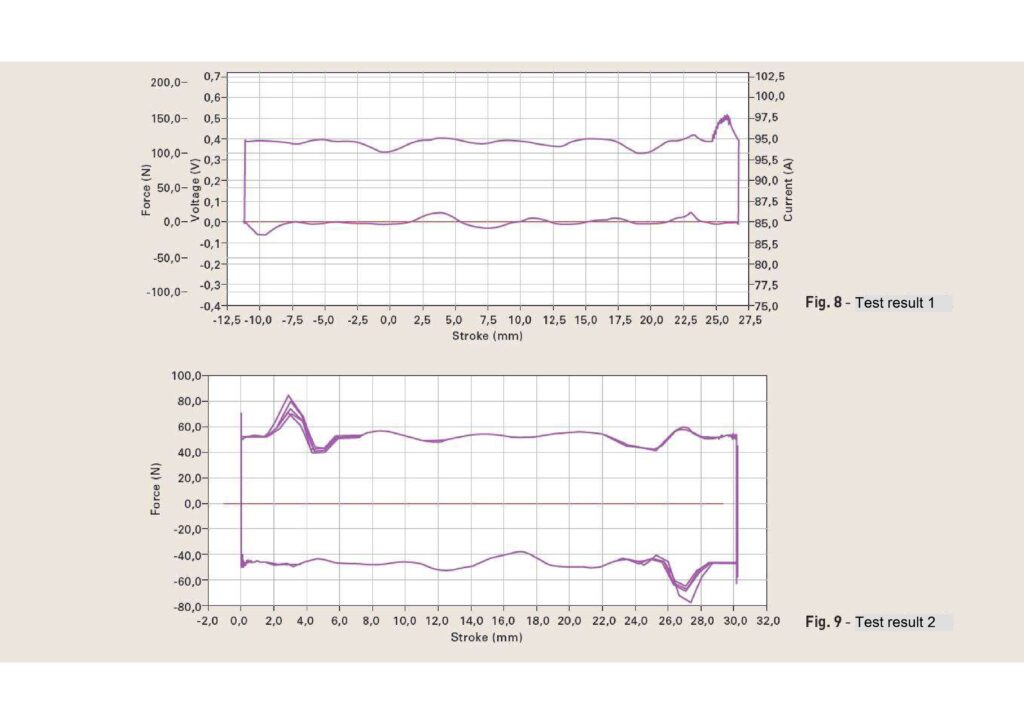
Testing campaigns demonstrated excellent repeatability and stable force control, with deviations limited to approximately ±10% at motion reversal points a highly acceptable range given the dynamic complexity involved. Multiple consecutive cycles confirmed reliability and control system robustness.
A Platform for the Future of Aerospace Testing
The final outcome is more than a test bench; it is a scalable and technologically advanced validation platform. By replacing traditional fluid-based load systems with an intelligent electric solution, Excogita has enhanced dynamic performance, simplified control architecture, reduced energy consumption, and lowered long-term operating costs.
This innovation supports aerospace manufacturers at every stage from early prototype validation to full certification and endurance testing of production-ready actuators. In an industry where safety margins are tight and performance expectations are uncompromising, such an adaptable and precise testing solution represents a decisive competitive advantage.
As aerospace systems continue evolving toward smarter, lighter, and more electrically driven architectures, testing technology must evolve accordingly. With its forward-thinking electric load concept and modular architecture, Excogita’s multifunctional test bench stands as a benchmark solution for next-generation aeronautical actuator validation.
For more information about this project and, more in general, about the Excogita test rigs for different applications, get in touch with ICT srl, info@consulting-trading.com, who is responsible of business development of Excogita’s machinery.