
Vishal Holani,
Director :- Holani bearings Pvt Ltd Rajkot Gujarat
The global manufacturing landscape has long been shaped by the contrasting trajectories of India and China. While China has emerged as the world’s manufacturing powerhouse, India has built a strong reputation in services and consumer-driven business models. As global supply chains undergo transformation and resilience becomes a strategic priority, India stands at a critical juncture poised to redefine its manufacturing future through innovation, policy reform, and infrastructure development.
China’s dominance in manufacturing is the outcome of decades of focused strategy and execution. Heavy investments in infrastructure ranging from ports and highways to industrial clusters have created an efficient ecosystem where goods move seamlessly from production lines to global markets. This efficiency is reinforced by tightly integrated supply chains that allow manufacturers to source, produce, and distribute at scale with minimal disruption. As a result, China has become the backbone of global manufacturing across industries such as electronics, automotive, and heavy engineering.
A key strength of this system lies in its strong B2B ecosystem. Suppliers, component manufacturers, and assemblers operate within highly coordinated networks, reducing costs and improving speed. Combined with access to skilled labor and policy support, this has enabled China to sustain its competitive edge for years.
India, on the other hand, has followed a different growth trajectory. Its economic rise has been powered by services, particularly in IT, digital platforms, and consumer-driven markets. The country has excelled in B2C and D2C models, where businesses connect directly with customers through technology. This has fueled rapid expansion in e-commerce and digital entrepreneurship, positioning India as a leader in innovation on the consumer side.
However, manufacturing has not kept pace. Challenges such as fragmented supply chains, inconsistent infrastructure, and regulatory hurdles have limited growth. To bridge this gap, India must focus on building a robust industrial base driven by technology and innovation.
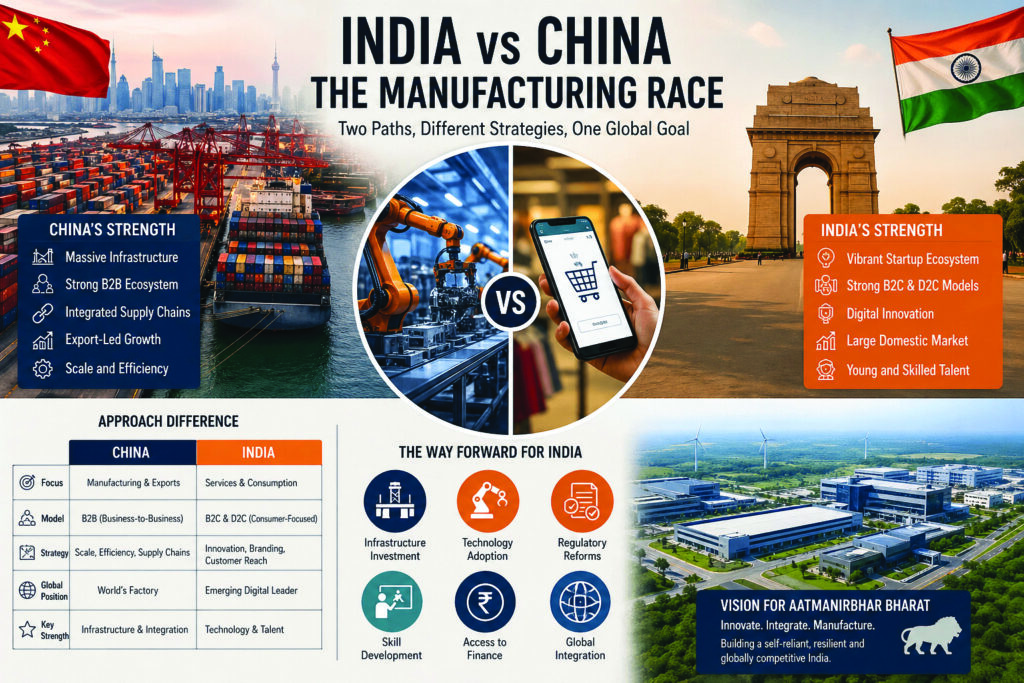
Adopting automation, robotics, and AI can significantly improve efficiency and quality. At the same time, stronger collaboration between industry, academia, and research institutions will help create a sustainable innovation ecosystem. Policy reforms especially those aimed at simplifying regulations and improving ease of doing business are equally critical.
With global supply chains shifting, India has a timely opportunity to strengthen its manufacturing capabilities. By aligning digital expertise with industrial development, the country can emerge as a competitive and resilient manufacturing hub on the global stage.