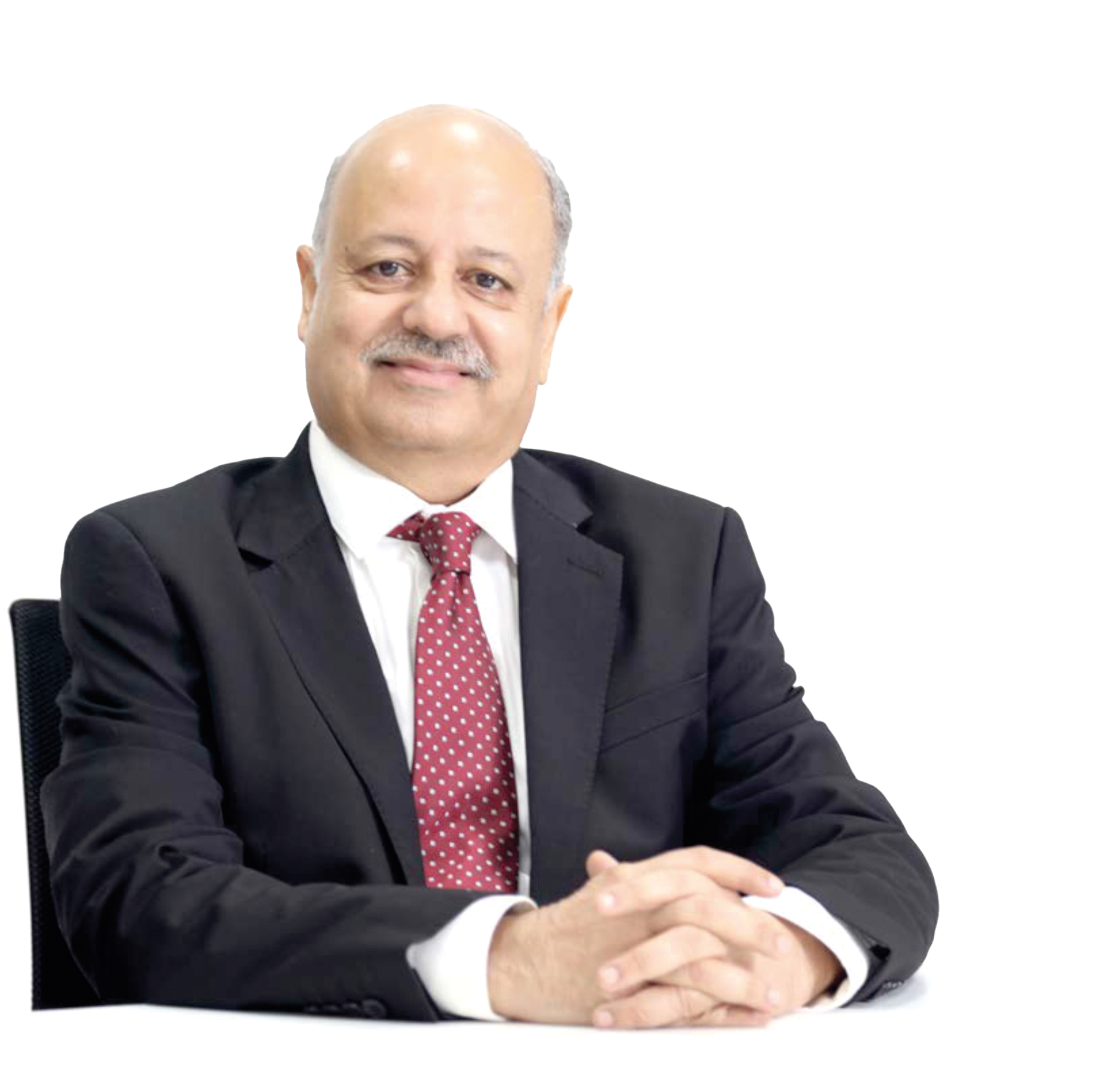

Vishal Holani , Director:- Holani bearings Pvt Ltd Rajkot Gujarat
As Bharat accelerates towards becoming a global manufacturing powerhouse, the bearing industry stands at a defining inflection point. Driven by infrastructure growth, automation, and rising industrial demand, domestic bearing manufacturing is no longer optional—it is strategic, urgent, and central to achieving a truly self-reliant industrial ecosystem.
The Silent Backbone of Industrial Growth
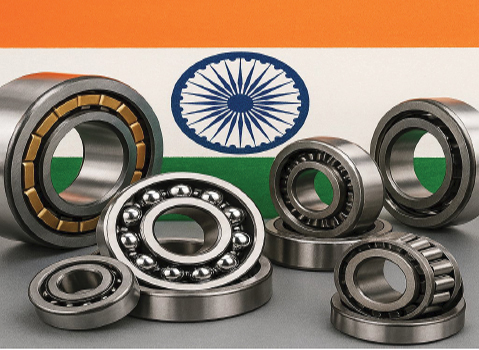
Bearings may be small components, but their impact on industrial performance is immense. From automobiles and railways to wind energy, aerospace, and heavy machinery, bearings enable efficiency, reliability, and motion. As Bharat’s economy continues to grow at over 6%, with long-term projections even higher, the demand for high-quality bearings is expanding at an unprecedented pace.
Industry estimates suggest that Bharat’s bearing market is set to grow at a CAGR ranging between 9.5% and 14.5% over the next decade. This growth is not incidental—it is being fuelled by large-scale industrialisation, rapid infrastructure expansion, and increasing adoption of automation and advanced manufacturing technologies.
Imports Rising Faster Than Domestic Capacity
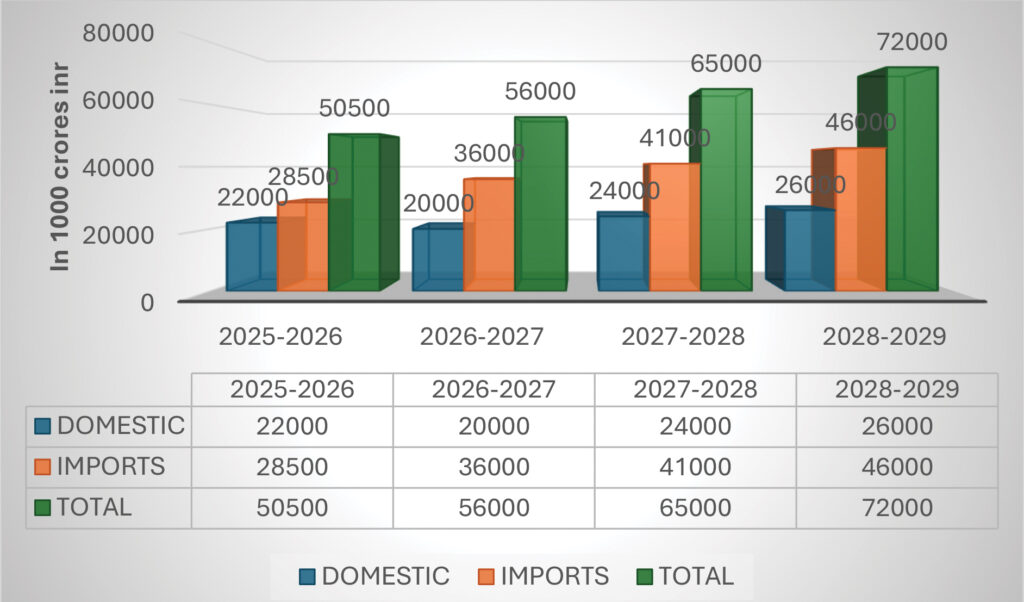
Despite strong demand fundamentals, a critical imbalance has emerged. Imports of bearings have now overtaken domestic production, with import values already touching approximately ₹28,000 crore and projected to cross ₹40,000 crore in the near term. This widening gap highlights a pressing challenge: Bharat’s manufacturing capacity has not scaled at the pace required to meet domestic consumption.
Over the last two decades, while global competitors—particularly China—have rapidly expanded capacity through technology adoption and scale, Bharat’s bearing production has remained relatively stagnant. The influx of low-cost, often substandard imports has further disrupted local supply chains and intensified price competition for domestic manufacturers.
MSMEs: The Industry’s Strong Foundation
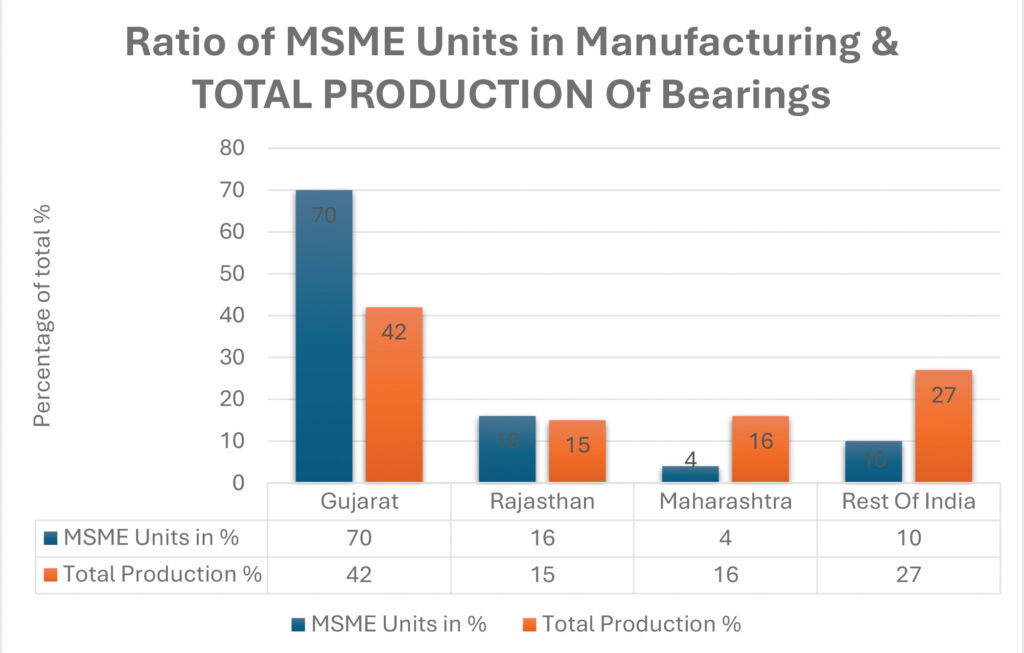
The strength of Bharat’s bearing industry lies in its MSME ecosystem. More than 1,500 MSME units operate across the country, forming the backbone of component manufacturing and supply. Gujarat and Rajasthan have emerged as major hubs, together accounting for a significant share of both production capacity and supplier networks.
Bearing manufacturing is inherently precision-driven and labour-intensive. It demands skilled manpower, advanced machinery, and consistent quality control across raw materials, forgings, rollers, cages, and grinding operations. Strengthening this ecosystem through technology access, automation, and skill development is critical for long-term competitiveness.
The Case for Quality and Fair Competition
The industry’s call is not for protectionism, but for fairness. The absence of comprehensive quality benchmarks has allowed substandard imports to enter the market, undermining both safety and domestic industry viability. The implementation of Quality Control Orders (QCOs) for bearings is therefore seen as a crucial step forward.
QCOs would ensure uniform standards across imported and domestically manufactured bearings, creating a level playing field. More importantly, they would encourage innovation, push manufacturers to upgrade processes, and improve global competitiveness—ultimately enabling Indian manufacturers to scale exports sustainably.
Strategic Importance in a VUCA World
In an increasingly volatile, uncertain, complex, and ambiguous global environment, domestic manufacturing has taken on strategic importance. Reducing import dependency conserves foreign exchange, strengthens supply chain resilience, and enhances economic sovereignty. For a nation aspiring to become a developed economy by 2047, bearings are not just components—they are strategic assets.
Aligned with national initiatives such as Make in India and the government’s focus on engineering exports, a strong domestic bearing industry can deliver multiplier effects—boosting capital goods manufacturing, creating skilled employment, and contributing directly to GDP growth.
The Road Ahead
Bharat’s bearing industry stands at a decisive crossroads. With demand accelerating and global supply chains rebalancing, the opportunity to emerge as a leading global bearing manufacturing hub is real. However, realising this potential will require coordinated action—policy support, enforcement of quality standards, technology upgradation, and collective industry collaboration.
A robust domestic bearing ecosystem will not only support industrial growth but also reinforce Bharat’s journey towards becoming a Viksit Bharat. The moment is now, and the direction is clear: build quality, scale capacity, and power the future from within.