
Aerospace bearings sit at the intersection of precision engineering, safety, and national capability. Unlike conventional bearings, they operate under extreme conditions with zero tolerance for failure. For Indian manufacturers and distributors, this niche sector offers long-term value and strategic relevance but only to those prepared for its technical rigor, certification discipline, and relationship-driven market dynamics.
This article is authored by Vikas Manral, Founder of VAM Consulting, a boutique advisory firm focused on the aerospace and defense sector. With over two and half decades of experience across manufacturing, business strategy, and market development in aerospace, the author has worked closely with bearing applications spanning aircraft, helicopters, aeroengines, space systems, missiles, and UAVs. The perspectives shared are based on practical exposure to global aerospace bearing ecosystems and the evolving Indian industrial landscape. This article aims to provide Indian bearing manufacturers and distributors with a realistic understanding of the aerospace bearing domain, highlighting both the opportunity and the discipline required to participate successfully in this highly specialized and strategic sector. Aerospace bearings occupy a unique position in the bearing world. While bearings are universally perceived as mechanical components that enable motion, aerospace bearings go far beyond this basic definition. They are safety-critical elements that operate in extreme environments, often with zero tolerance for failure, and their performance directly impacts mission success, human safety, and national capability. For Indian bearing manufacturers and distributors, aerospace bearings represent both a significant opportunity and a formidable challenge. The sector is niche, technically demanding, and relationship-driven, but it also offers long product lifecycles, stable demand, and strategic importance that few other industries can match.
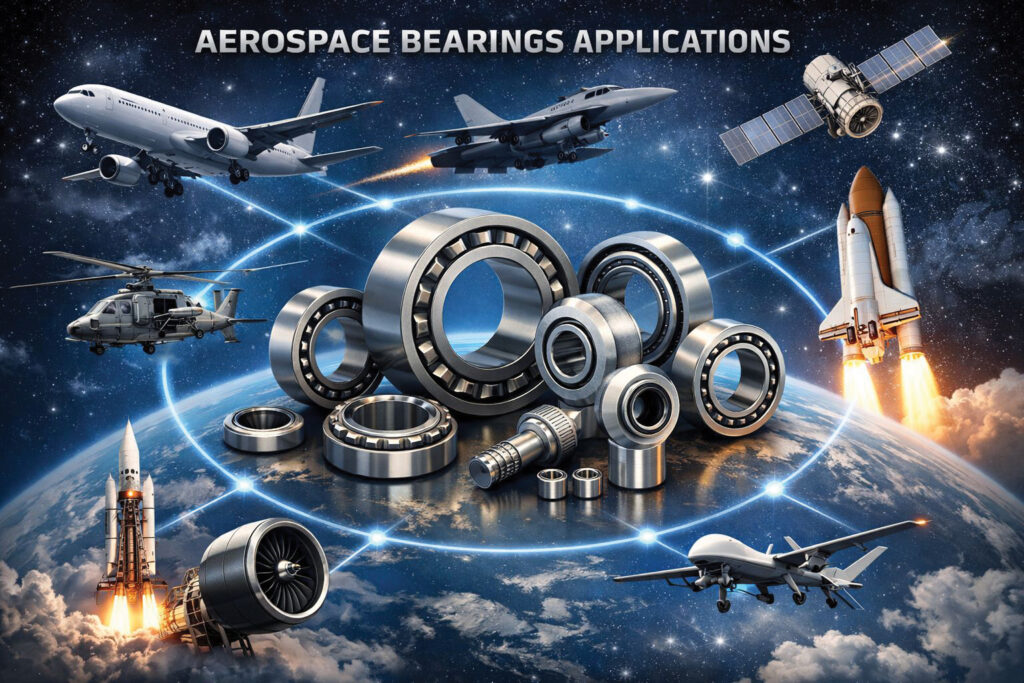
Aerospace bearings are used across a wide spectrum of applications including fixed-wing aircraft, helicopters, aeroengines, space systems, missiles, and unmanned aerial vehicles. Unlike automotive or industrial bearings, these applications are characterized by low volumes, high mix, and very specific operating conditions. Some bearings rotate at extremely high speeds under controlled lubrication, while others operate under oscillatory motion, high loads, shock, vibration, temperature extremes, vacuum, or corrosive environments. In many cases, bearings may rotate only a few degrees repeatedly over their entire life, yet must survive tens of thousands of cycles without measurable degradation. This diversity of operating profiles makes aerospace bearing design fundamentally different from catalogue-driven industrial products.
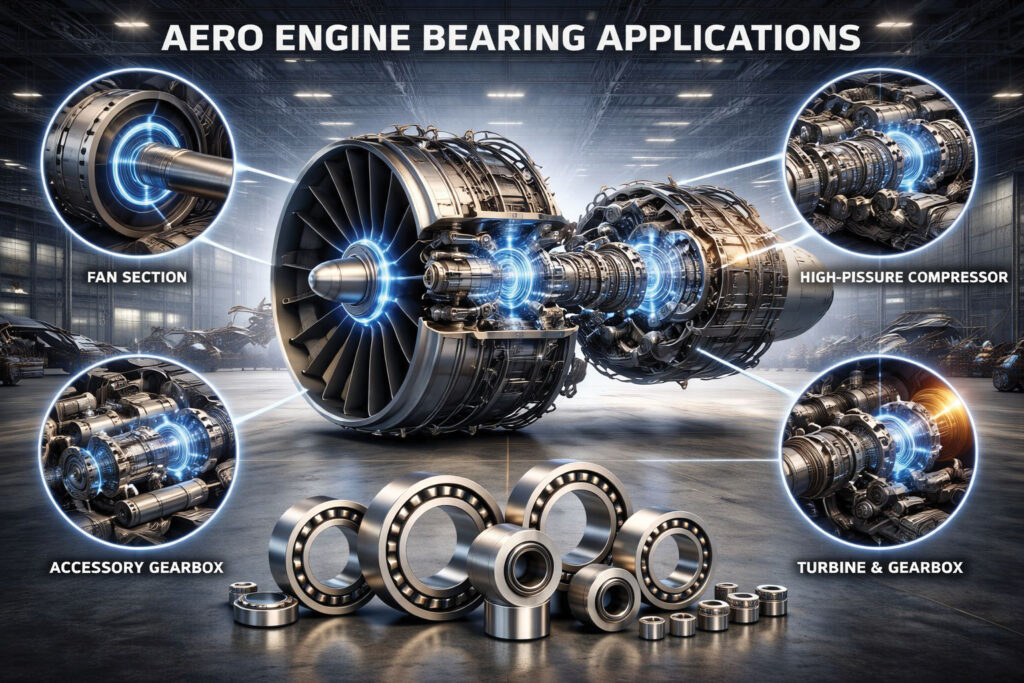
Design is the first major barrier to entry. Aerospace bearings are rarely selected purely on load and speed ratings. They are designed as part of a system, often co-developed with the customer, and optimized for weight, stiffness, life, lubrication philosophy, and integration with surrounding structures. Material selection plays a decisive role, not only for rings and rolling elements but also for cages, liners, coatings, and surface treatments. Corrosion resistance, fatigue life, wear behavior, and compatibility with lubricants or dry-film systems must be understood in depth. In space and missile applications, the absence of conventional lubrication forces designers to rely on solid lubricants or special surface engineering solutions. In aeroengine applications, the challenge is to balance very high rotational speeds, thermal stability, and dimensional accuracy over long operating cycles. These are not problems that can be solved by copying existing designs; they require domain knowledge, simulation capability, and iterative validation.
Certification is the second and often underestimated hurdle. Aerospace bearings are not qualified by internal inspection alone. They are qualified as part of a regulated ecosystem that includes design approval, process control, traceability, testing, and documentation. Certification expectations differ between civil aerospace, defense, and space, but the underlying principle remains the same: the supplier must demonstrate that every bearing delivered is identical in intent and execution to the one that was originally qualified. This requires robust quality management systems, controlled special processes, disciplined change management, and a culture of compliance. For Indian companies entering this space, the learning curve is steep, as aerospace customers do not buy products alone; they buy confidence in the supplier’s systems, people, and long-term commitment.
Manufacturing aerospace bearings demands a mindset shift from volume efficiency to process capability. Tight tolerances, controlled cleanliness, specialized heat treatment, precision grinding, and surface finishing are table stakes. Equally important is the ability to measure what is manufactured, including geometry, surface integrity, residual stresses, and functional parameters such as torque or friction behavior. Many aerospace bearings are assembled, lubricated, and sealed under controlled environments, and even minor deviations can result in rejection. Unlike industrial markets where rework or sorting may be acceptable, aerospace manufacturing places a premium on “right first time” execution. For Indian manufacturers accustomed to cost-driven markets, this transition requires investment not only in machines but also in skills, metrology, and process discipline. From a market perspective, the Indian aerospace and defense ecosystem is evolving rapidly. Indigenous aircraft, helicopters, missiles, UAVs, and space programs are expanding, while global supply chains are actively looking to diversify. This creates a window of opportunity for Indian bearing manufacturers and distributors who are willing to invest in capability building. However, it is important to recognize that aerospace bearing markets do not reward opportunistic entry. Customers expect long-term engagement, technical support, and continuity over decades. Programs may take years to mature, and initial volumes may be small, but once qualified, suppliers often remain on the platform for the entire lifecycle.
Distributors also have a meaningful role to play in this ecosystem. Aerospace bearing distribution is not about moving boxes; it is about technical interface, application understanding, and supply chain reliability. Proactive distributors who invest in aerospace knowledge, documentation handling, and customer engagement can become trusted partners rather than transactional intermediaries. In many cases, distributors serve as the first point of contact for indigenization, alternate sourcing, or lifecycle support. However, this requires patience, credibility, and a willingness to operate at lower volumes while building long-term value.
One of the most critical messages for Indian companies is that aerospace bearings are not an extension of automotive or industrial bearing businesses. They are a distinct domain with their own rules, language, and expectations. Success depends on guidance, mentorship, and structured learning. Companies that attempt to enter the sector without understanding certification pathways, customer behavior, and technical depth often face frustration and slow progress. Conversely, those who approach the market with humility, preparation, and the right advisory support can gradually build a sustainable position.
In conclusion, aerospace bearings represent a high-entry-barrier but high-value opportunity for Indian manufacturers and distributors. The sector rewards technical competence, system thinking, and long-term commitment rather than short-term volume play. As India continues to strengthen its aerospace and defense capabilities, the need for reliable, indigenous bearing solutions will only grow. For those willing to invest in knowledge, processes, and relationships, aerospace bearings can become not just a business opportunity but a strategic contribution to the nation’s industrial maturity.