
Vishal Holani,
Director Holani bearings Pvt Ltd Rajkot Gujarat
India’s bearing manufacturing industry stands at a defining moment. What appears to be a wave of affordable imports is, in reality, a structural challenge threatening domestic production, skilled employment, and long-term industrial self-reliance. With ultra-cheap bearings and components flooding the market primarily from China the sector faces a crisis that extends beyond trade balances into the very foundation of India’s manufacturing ecosystem.
The global bearing manufacturing landscape is largely anchored by India and China in terms of production volumes. These two nations cater to the majority of the world’s standard bearing demand, forming the backbone of global industrial supply chains. In contrast, countries such as Japan, Germany, United States, South Korea, Italy and Sweden focus on high-precision and critical bearings used in aerospace, defence, and advanced engineering applications. This global division of labour places India in a pivotal role, supplying essential components to industries worldwide.
Yet, despite its strategic importance, India’s domestic bearing industry is steadily losing ground. Fifteen years ago, the country met over 80% of its bearing requirements locally. Today, nearly half of India’s annual demand estimated at ₹30,000–35,000 crore is met through imports, with Chinese products dominating volumes. In segments like ball bearings, imports reportedly account for almost 90% of the total inflow. Such dependence on a single foreign source for a critical industrial input poses serious risks to supply chain resilience and national economic stability.
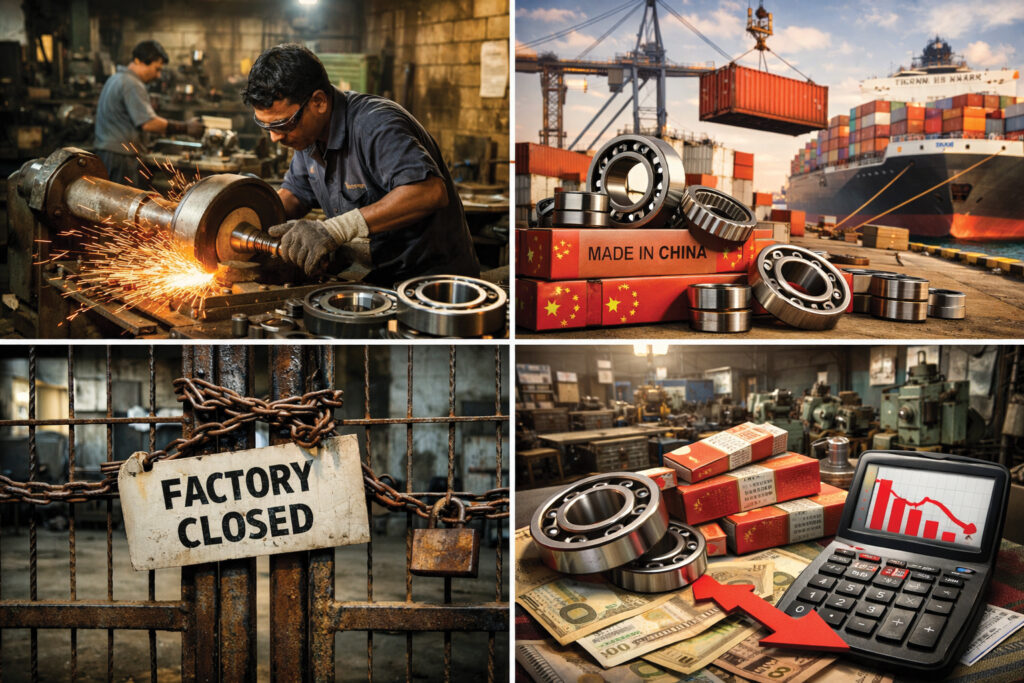
The heart of the crisis lies in what industry stakeholders describe as a “pricing paradox.” According to insights from the Bearings & Components Manufacturers Association of India (BCMAI), finished bearings imported from China are often priced lower than the cost of raw steel required for domestic production. In some cases, imported bearings enter the Indian market at just 20–25% of the cost incurred by Indian manufacturers. Even tapered rollers are reportedly priced below the domestic cost of basic steel wire rods.
Such distortions make fair competition impossible. Indian bearing manufacturers largely MSMEs operate within stringent quality and precision frameworks. Processes like heat treatment, grinding, precision machining, testing, and assembly significantly add to production costs. Competing against imports that seemingly bypass economic fundamentals amounts to commercial suffocation rather than healthy market rivalry.
The implications go beyond pricing. Concerns around under-invoicing and misdeclaration suggest potential revenue losses to the exchequer, while low-grade materials and substandard heat treatment in cheap imports raise safety risks. Premature bearing failures can disrupt transport systems, power plants, and heavy engineering operations, where reliability is non-negotiable.
The human cost is already visible. Manufacturing hubs in Gujarat, Rajasthan, NCR, and Punjab have witnessed closures of small and medium bearing units. Skilled workers face job insecurity, and expansion plans aligned with national initiatives like Make in India have stalled due to uneven trade conditions.
Industry voices, including Vishal Holani, Director at Holani Bearings Pvt Ltd and a leader within BCMAI, stress that urgent implementation of Quality Control Orders (QCO) and stricter Bureau of Indian Standards (BIS) norms is essential. These measures are not protectionist they are safeguards to ensure fair trade and product integrity.
India now faces a strategic choice: remain a consumption-driven market for low-cost imports or reinforce its position as a resilient manufacturing powerhouse. The bearing sector, foundational to automobiles, railways, defence, and infrastructure, may well determine the direction of that choice.