
Vikas Manral,
Founder VAM Consulting
As India accelerates indigenous fighter aircraft, helicopter platforms, UAV systems and ambitious space missions, the spotlight is shifting from assembly participation to engineering ownership. At the heart of this transition lies a deceptively small but strategically critical component aerospace bearings. In this top story, Vikas Manral, Founder of VAM Consulting, outlines why aerospace bearing indigenisation is not merely a localisation initiative, but a defining test of India’s aerospace capability maturity.
India’s aerospace ecosystem stands at an inflection point. Indigenous platforms are no longer developmental aspirations; they are operational necessities. From advanced fighter programs to next-generation helicopters and expanding space missions, reliability, lifecycle assurance, and performance predictability have become non-negotiable. In this context, aerospace bearings represent far more than mechanical elements they are precision-engineered interfaces where materials science, tribology, load dynamics, and lifecycle engineering converge.
Unlike industrial bearings, aerospace bearings operate under extreme conditions: fluctuating load spectra, thermal cycling, vibration environments, and stringent fatigue life requirements. Their performance directly influences engine efficiency, rotor stability, vibration control, and overall mission readiness. A single unplanned failure is unacceptable. Therefore, indigenisation in this domain is not a procurement decision it is a capability declaration.
India has built strong competencies in machining, fabrication, avionics integration, and program execution. However, aerospace leadership demands more than build-to-print excellence. The critical shift lies in moving toward build-to-spec capability and ultimately toward co-design authority.
Build-to-print manufacturing ensures dimensional conformity. Build-to-spec manufacturing demands functional understanding. Aerospace bearings must be engineered not only to match drawings but to deliver predictable behaviour across tens of thousands of operational hours. This requires mastery over fatigue modelling, subsurface stress behaviour, lubrication film dynamics, vibration damping characteristics, and thermal stability.
Without this functional depth, localisation risks producing components that are dimensionally accurate but behaviourally uncertain a gap that global aerospace OEMs cannot tolerate.
Material science forms the foundation of aerospace bearing reliability. Traditional alloys such as M50 and high-grade martensitic stainless steels remain important, but advanced applications increasingly demand vacuum-induction melted and vacuum-arc remelted steels, powder metallurgy grades, hybrid ceramic rolling elements, and high-performance superalloys. These materials offer enhanced fatigue resistance, thermal stability, and wear performance.
However, aerospace-grade material availability remains a structural bottleneck. Small prototype batch requirements often clash with global supplier minimum order volumes, and domestic production of specialised alloys remains limited. A sustainable indigenisation roadmap must therefore include strategic partnerships with specialty alloy producers, development of qualified domestic melting capabilities, traceable certification frameworks, and inventory models that support prototyping without excessive capital strain.
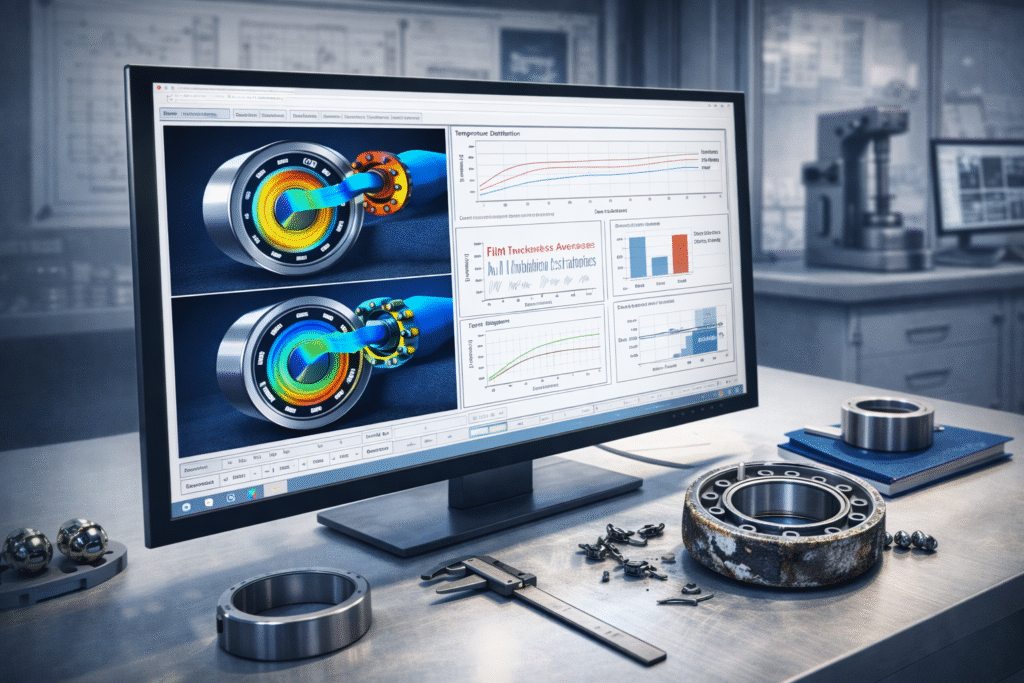
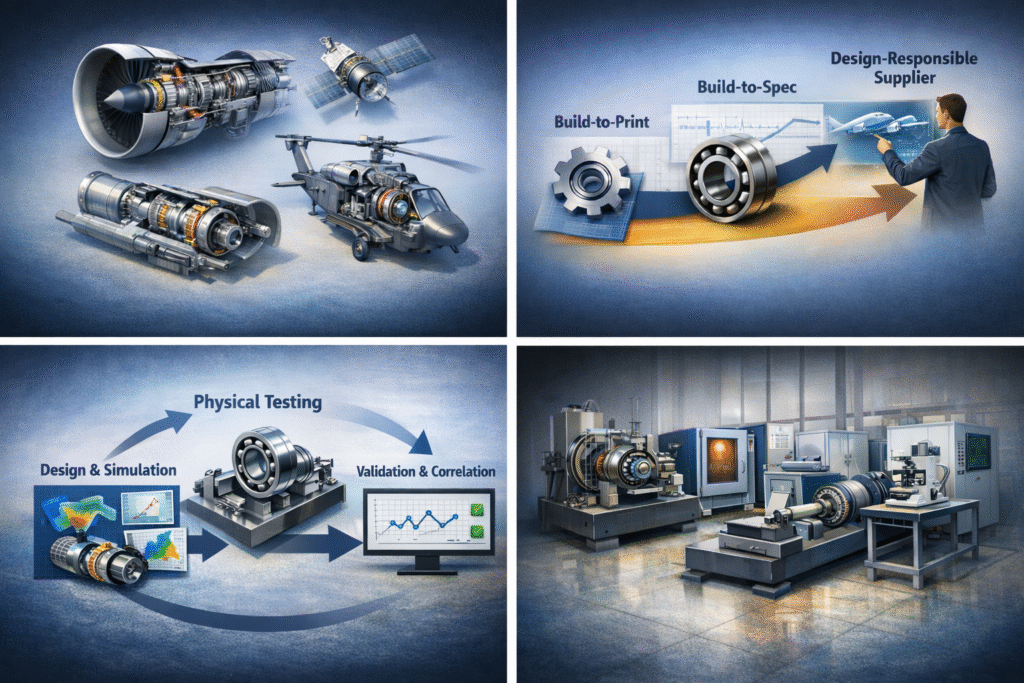
Equally critical is the integration of simulation-driven engineering. Modern aerospace bearing development leverages advanced finite element analysis, multi-body dynamics, and computational tribology to predict rolling contact stresses, lubrication breakdown regimes, crack propagation, and thermal behaviour. Simulation does not replace testing; it sharpens it. It reduces prototype cycles, identifies failure modes early, and strengthens validation confidence.
India possesses strong simulation expertise in automotive and heavy engineering sectors, but aerospace bearing life prediction under complex mission loads demands specialised talent and targeted investment. Building this capability internally or through strategic collaborations will be essential for credible global participation.
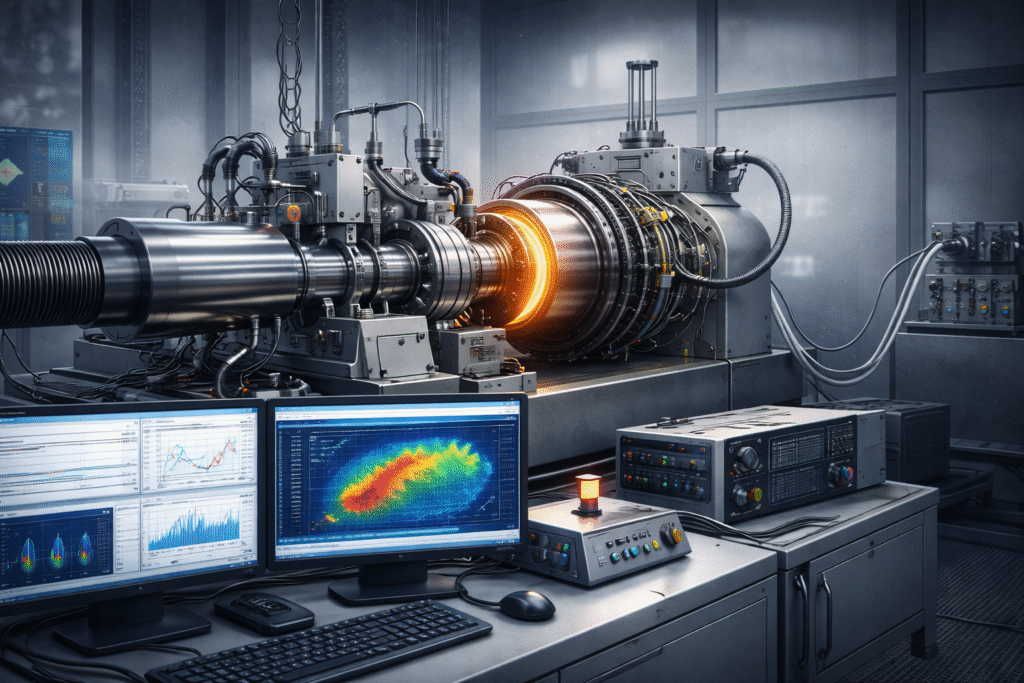
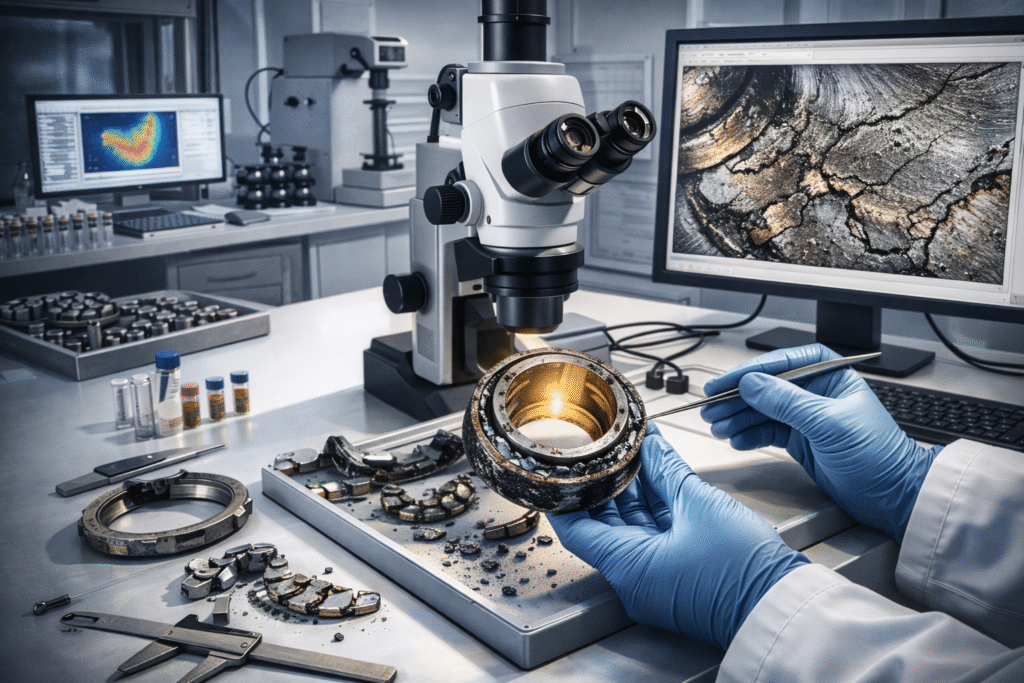
Physical validation, however, remains indispensable. High-speed endurance testing, vibration and shock simulations, thermal cycling, and lubrication system validation are central to certification. Currently, aerospace bearing testing infrastructure in India remains fragmented and often program-specific. Establishing shared, neutral testing facilities accessible to industry, academia, defence organisations, and OEM integrators would dramatically accelerate qualification timelines and lower entry barriers for emerging suppliers.
Strategically, Indian manufacturers must adopt a phased roadmap. Not all aerospace bearings carry identical technical complexity or business potential. Prioritisation should align with domestic platform requirements and realistic return-on-investment scenarios. Early engagement with OEMs, development of lifecycle literacy, and cultivation of traceability-focused organisational cultures are critical.
For leadership teams, aerospace bearing indigenisation is not a short-term revenue play. It is a multi-year capability investment defined by modest volumes, high accountability, and engineering intensity. Companies that succeed will not simply replace imports they will emerge as trusted aerospace partners capable of influencing design, performance optimisation, and lifecycle assurance.
In aerospace, true maturity is measured not by scale alone, but by engineering ownership. Bearings may be small in size, but in India’s aerospace journey, they represent a frontier of strategic significance.