
Vishal Holani
Holani bearings Pvt Ltd Rajkot Gujarat
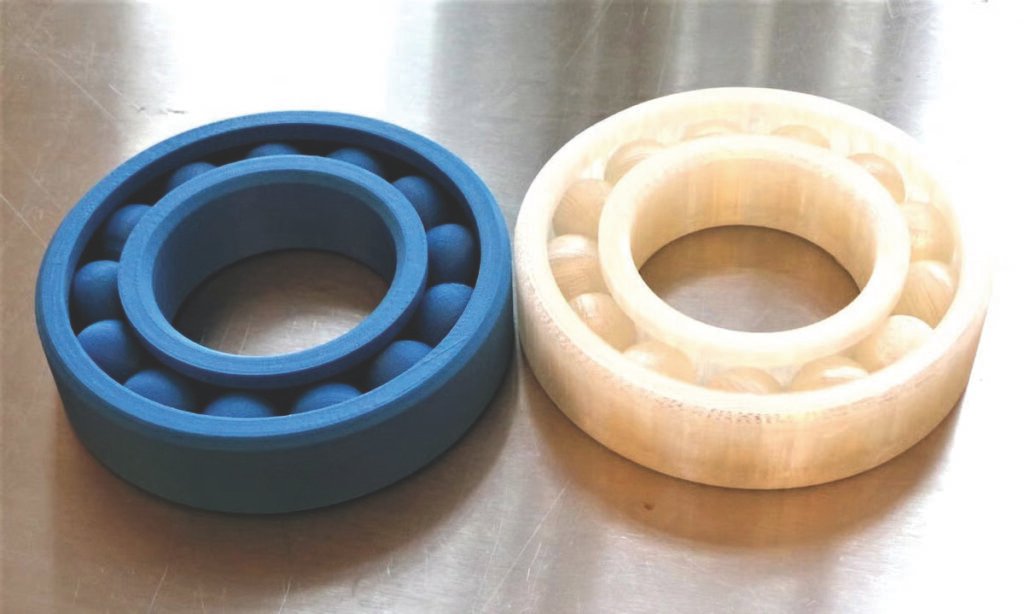
As India works toward the vision of Viksit Bharat 2047, manufacturing technologies that improve speed, flexibility and self-reliance are gaining attention across engineering industries. One such technology is 3D printing, also known as additive manufacturing, which builds components layer by layer directly from a digital design.
In bearing production, 3D printing is not yet replacing traditional methods such as forging, turning, heat treatment, grinding and super-finishing. However, it is creating new space for customised bearing cages, lightweight housings, integrated lubrication channels, prototype assemblies and replacement parts where design flexibility matters more than high-volume output
Design Freedom Is the Biggest Advantage
The strongest case for 3D-printed bearing development lies in design freedom. Engineers can create complex shapes that are difficult or costly to make through conventional machining. Bearing housings and support structures can be redesigned with lattice patterns and topology-optimised forms, reducing weight while maintaining strength.
Smarter Lubrication and Faster Repairs
Another important opportunity is lubrication. Bearing failure is often linked to heat, friction and poor oil flow. Traditional machining usually limits engineers to straight drilled holes, while metal 3D printing can create curved internal channels that guide oil or cooling fluid closer to high-friction zones.
In repair situations, technologies such as directed energy deposition and cold spray may rebuild worn areas before final machining restores the required dimensions. This makes additive manufacturing attractive not only for new product development, but also for extending the life of expensive industrial components.
Costing: Useful for Prototypes, Expensive for Standard Parts
Cost is one of the first questions for any bearing company exploring this technology. In India, a small plastic prototype bearing or cage made using basic FDM or SLS printing may start from around ₹10000 to ₹15,000. A functional nylon, carbon-fibre-reinforced polymer or PEEK-based prototype can range from about ₹35,000 to ₹50,000, depending on size, material and finishing needs.
Metal bearing components are more expensive. A small stainless-steel housing, cage or customised bearing support printed through DMLS, SLM or binder-jetting services may cost roughly ₹50,000 to ₹100,000 during the development stage. More demanding titanium, Inconel or precision-machined prototypes can exceed ₹1.5 lakh once heat treatment, support removal, grinding, polishing and inspection are included.
Therefore, 3D printing is most economical when the part is customised, complex, urgent, low-volume or difficult to manufacture conventionally. For standard bearing sizes produced in large batches, conventional production remains far cheaper per piece.
Choosing the Right Material Is Critical
Material selection is critical because a bearing must deal with friction, load, heat, lubrication, corrosion and dimensional accuracy. For early concept trials, engineers may use PA12 nylon, glass-filled nylon, carbon-fibre-reinforced nylon, acetal-like engineering polymers or PEEK-based materials for cages, retainers and low-load prototypes.
For metal housings, supports, outer rings or special industrial prototypes, common choices include stainless steel 316L, maraging steel, aluminium alloy AlSi10Mg, titanium Ti6Al4V, tool steels and nickel alloys such as Inconel 718. The powder must be clean, spherical, flowable and suitable for the selected printing process, with controlled particle size, low oxygen contamination, traceability and a proper material certificate.
For high-speed and high-load rolling elements, conventional bearing steel balls and precision-ground races are still generally preferred. At present, 3D printing is better suited to cages, housings, lubrication channels, customised mounts and support structures rather than complete high-performance bearings.
Sourcing can be done either by purchasing certified polymer filament, SLS powder or metal powder from qualified additive-manufacturing material suppliers, or by working with a 3D-printing service bureau that already has approved materials, machines and post-processing facilities. MSMEs should ask for datasheets, batch certificates, powder reuse policy, printing parameters, tolerance capability, surface roughness, heat-treatment route and inspection reports before placing development orders.
Government Support Is Building the Ecosystem
Government support is also helping shape India’s additive-manufacturing ecosystem. The Ministry of Electronics and Information Technology has promoted the National Strategy for Additive Manufacturing to build domestic capability in machines, materials, software, start-ups, products and skilled manpower.
The National Centre for Additive Manufacturing in Hyderabad, supported by the Government of India and the Government of Telangana, is intended to encourage research, product development, testing and collaboration between industry and academic institutions. Such centres can help start-ups and MSMEs explore bearing-related prototypes without immediately investing in expensive machines.
The Ministry of MSME’s Technology Centre Systems Programme is also expanding technology centres with advanced manufacturing capabilities such as additive manufacturing, CNC machining, robotics, metrology, calibration and testing. For small engineering units, these facilities may reduce the cost and risk of experimentation.
Why It Is Still Behind Mass Commercial Production
Despite its promise, 3D printing still has a long way to go before it can compete with conventional bearing production at mass scale. Traditional bearing factories are designed to produce millions of identical parts through controlled forging, machining, heat treatment, grinding, super-finishing and automated inspection. These processes deliver repeatability, speed and low cost that additive manufacturing cannot yet match for standard bearings.
The biggest barriers are production speed, surface finish, repeatability and post-processing. A printed metal bearing component may require support removal, stress relief, heat treatment, machining, grinding, polishing and inspection before it approaches the quality required for rolling contact. Even small variations in powder quality, laser settings, build orientation or cooling rate can affect density, hardness and fatigue life.
Certification is another challenge. Automotive, railway, aerospace, mining and process industries expect bearings to meet strict life-cycle, vibration, noise, hardness and fatigue standards. Until printed bearing components can prove the same consistency over long production runs, customers will continue to trust conventional precision-ground steel bearings for critical applications.
For this reason, the immediate future is likely to be hybrid. Conventional bearing steel will remain the backbone for balls, rollers and races, while 3D printing will grow in cages, housings, lubrication systems, customised fixtures, repairs and small-batch engineering solutions.
The Road Ahead
For Indian bearing manufacturers, the message is clear: 3D printing should not be seen as a direct replacement for proven mass-production lines, but as a strategic development tool. It can shorten product-development cycles, support customised solutions, reduce dependency on imported special parts and help companies experiment with new designs.
If industry, government, research institutions and MSMEs work together, additive manufacturing can become an important part of India’s advanced manufacturing journey. Bearings may remain a precision industry at heart, but 3D printing is giving that industry new tools to design, test, repair and innovate for the future.
For more info:
www.hblbearings.com