
Vikas Manral,
Managing Consultant ,VAM Consulting
In the world of aerospace engineering, reliability is non-negotiable. Among the many components that ensure safe and efficient aircraft operation, aeroengine bearings play a vital role. Despite their compact size, these precision-engineered components endure extreme operating conditions and are subjected to one of the most rigorous certification processes in modern engineering. Their journey from design to airworthiness is a remarkable story of innovation, testing, and uncompromising quality.
Aeroengine bearings are among the most critical elements within an aircraft propulsion system. Their primary function is to support rotating shafts, maintain rotor alignment, reduce friction, and facilitate efficient power transmission under extreme temperatures, high rotational speeds, and significant mechanical loads. Because a bearing failure can have severe consequences for engine performance and flight safety, every aeroengine bearing must undergo extensive evaluation before it is approved for operational use.
These bearings are commonly found in key areas of the engine, particularly within the low-pressure, intermediate-pressure, and high-pressure spool systems. Operating under intense thermal and mechanical stresses, they are responsible for maintaining rotor stability and ensuring precise shaft alignment. Their performance directly affects engine efficiency, durability, and overall reliability. Additionally, bearings used in accessory gearboxes support essential systems such as fuel pumps, lubrication assemblies, generators, and hydraulic units, making them equally important to uninterrupted engine operation.
The certification process begins long before a bearing reaches the manufacturing floor. Engineers first conduct detailed design analyses focused on material selection, internal geometry, lubrication pathways, rolling elements, and cage configurations. Advanced simulations evaluate fatigue life, stress distribution, thermal behavior, shaft dynamics, and lubrication performance. At this stage, extensive Failure Mode, Effects and Criticality Analysis (FMECA) is performed to identify potential risks such as wear, skidding, lubrication starvation, thermal instability, and cage failure.
Following analytical validation, the design progresses through multiple review stages where specialists assess technical feasibility, compliance requirements, manufacturing readiness, and quality expectations. Only after successfully passing these reviews does the bearing move into prototype development.
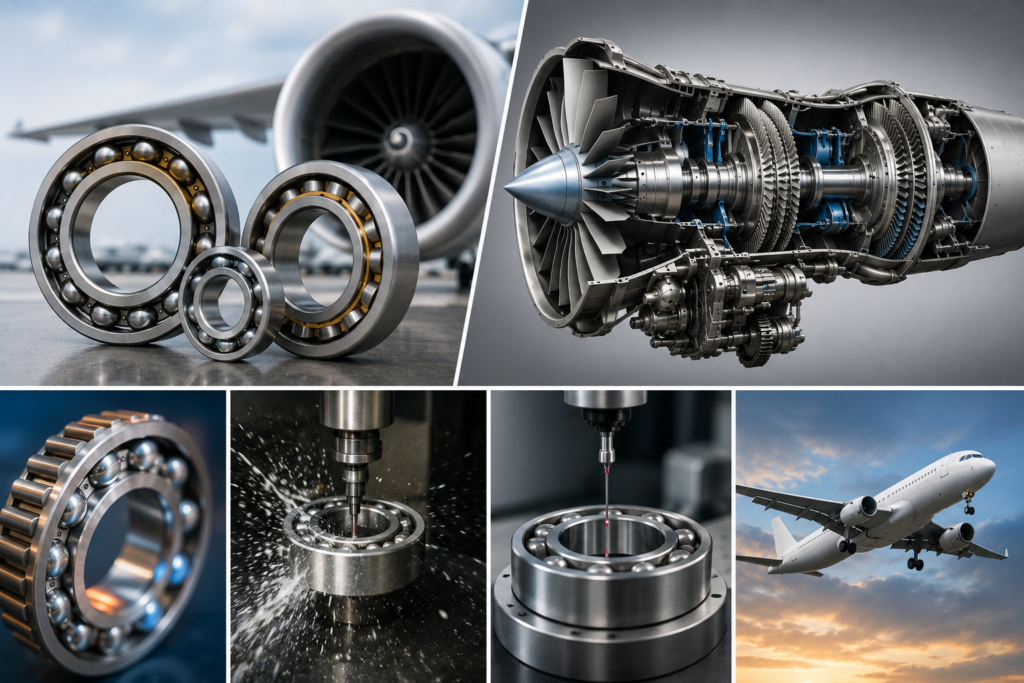
Manufacturing aeroengine bearings requires extraordinary precision and process control. Aerospace-grade materials undergo stringent inspection to verify chemical composition, forging quality, cleanliness, and heat-treatment integrity. Every production step, from grinding and raceway finishing to superfinishing and cage manufacturing, is closely monitored. Even microscopic defects can significantly impact fatigue life and operational reliability under demanding engine conditions.
Once prototypes are produced, they undergo a comprehensive series of inspections. Engineers evaluate surface finishes, dimensional accuracy, hardness levels, metallurgical properties, grain structure, rolling-element geometry, stiffness characteristics, and residual magnetism. These assessments ensure that each bearing meets the exacting standards required for aerospace applications.
Performance testing forms the foundation of certification. Bearings are subjected to simulated operating environments where engineers monitor vibration, friction torque, temperature behavior, lubrication effectiveness, and clearance stability. Qualification testing further validates load-carrying capacity, dimensional integrity, endurance performance, and operational reliability under accelerated mission conditions.
The final phase involves system-level and engine-level testing. Bearings are integrated into complete engine assemblies and exposed to endurance cycles, vibration loads, thermal fluctuations, contamination scenarios, oil interruptions, shock events, and environmental stresses such as altitude changes, dust, moisture, and temperature extremes. Although laboratory testing can replicate many operating conditions, actual flight trials remain indispensable for validating real-world performance and reliability.
Ultimately, aeroengine bearing certification represents far more than a regulatory requirement. It is a comprehensive demonstration of engineering excellence, safety assurance, and technological precision. Every certified bearing embodies years of research, meticulous manufacturing, exhaustive testing, and stringent evaluation. As aerospace technology continues to evolve, the rigorous certification of these small yet indispensable components will remain fundamental to ensuring safe, reliable, and efficient flight operations across the globe.