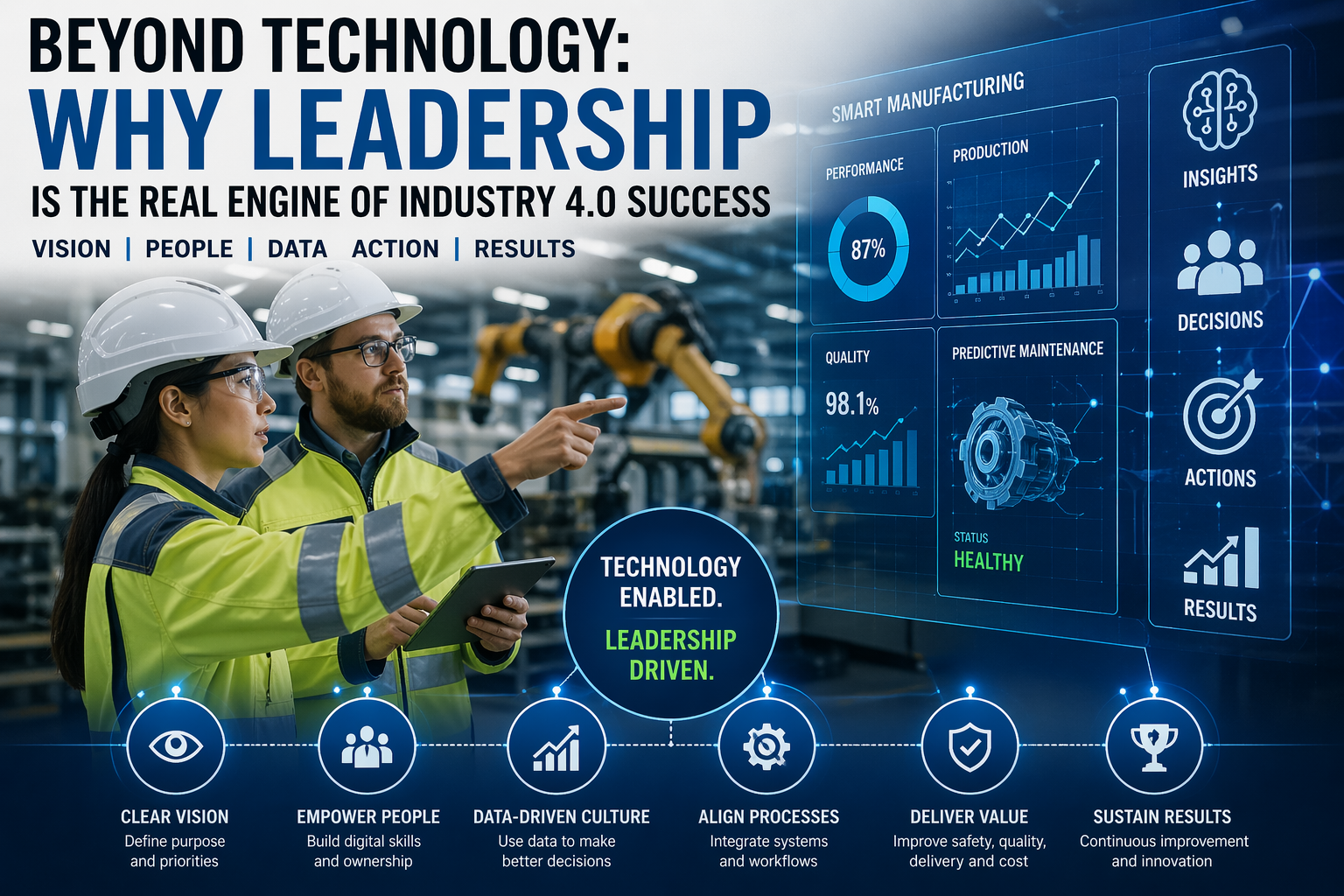
Industry 4.0 has rapidly evolved from a futuristic concept into a strategic priority for manufacturers worldwide. Yet, despite significant investments in automation, IoT, and data analytics, many organizations find themselves grappling with limited returns. The core issue isn’t the lack of advanced technology it’s the absence of leadership-driven transformation. Industry 4.0 is not just about smart machines; it is about smarter decision-making, cultural alignment, and a clear strategic vision led from the top.
Across the manufacturing landscape, the narrative around Industry 4.0 often revolves around digital tools sensors, connected systems, AI platforms, and real-time dashboards. While these technologies are essential enablers, they are not the ultimate drivers of success. On the shop floor, a different reality unfolds. Data may be abundant, but decisions frequently remain rooted in experience and instinct rather than insights. Systems are implemented, yet underutilized. The result is a growing disconnect between technological capability and operational impact.
This gap stems from a fundamental misunderstanding: treating Industry 4.0 as a technology upgrade instead of a business transformation. Many organizations begin their journey by asking what tools to invest in, rather than identifying the problems they need to solve. Without a clearly defined purpose, digital initiatives risk becoming fragmented efforts that generate data but fail to deliver value. The absence of measurable outcomes further fuels skepticism, especially among frontline teams who are expected to adapt without understanding the “why.”
Leadership plays a decisive role in bridging this gap. Successful Industry 4.0 transformations are anchored in clarity of vision and purpose. Leaders must define what success looks like whether it is reducing downtime, improving quality, enhancing safety, or optimizing costs. More importantly, they must establish how digital tools will enable these outcomes. This clarity ensures that every investment is aligned with tangible business objectives.
Equally critical is the role of leaders in shaping organizational behavior. Transformation does not occur when systems are installed; it happens when people change how they think and act. Leaders who consistently demand data-backed decisions, encourage structured problem-solving, and hold teams accountable for outcomes create an environment where digital adoption thrives. In contrast, when leadership remains detached, digital initiatives often lose momentum.
Another vital dimension is people development. Industry 4.0 does not diminish the role of human expertise it elevates it. Operators, supervisors, and engineers must evolve from being task executors to decision-makers empowered by data. This requires investment in digital literacy, training, and cross-functional collaboration. Organizations that prioritize skill development alongside technology adoption build a workforce capable of extracting real value from digital systems.
Looking ahead, the true promise of Industry 4.0 lies in focused, outcome-driven applications. Predictive maintenance can prevent costly breakdowns, quality analytics can minimize defects, and energy monitoring can drive sustainability. These are not abstract concepts but practical solutions that directly impact the bottom line. However, their success depends on leadership commitment and organizational alignment.
Ultimately, Industry 4.0 is less about machines and more about mindset. It is a journey that demands vision, discipline, and the courage to challenge traditional ways of working. Manufacturers who recognize this will not only unlock the full potential of digital transformation but also build resilient, future-ready enterprises in an increasingly competitive world.